2026 guide · Getting it done
How to Get AI Search Optimization Without Hiring a Full-Time Specialist
The honest answer is that most businesses should not hire for this yet. Not because the work doesn't matter, but because it isn't one job — it's four, and almost nobody does all four. This guide breaks down what a full-time hire really costs in 2026, compares the four realistic ways to get the work done with actual prices, hands you the part you can genuinely do yourself this month, and names the part you can't.


What the market actually looks like in 2026. Adobe Digital Insights (January 2026), State of AI Search 2026 by AirOps and Kevin Indig, Sloane Staffing's review of 50+ job postings (mid-2026), and Digital Elevator's 2026 AEO/GEO pricing guide.
Want these numbers for your business?Book your free demo
This is not one job. It is four

The question comes up at all because “AI search optimization” sounds like a single skill you could hire for, the way you would hire a graphic designer. It isn't. When Sloane Staffing reviewed more than fifty job postings in mid-2026, the roles split cleanly into four separate competencies, and almost no candidate had all four.
- Technical. Structured data, making your site legible to AI crawlers, site architecture. Mostly build-time work: done properly once, then maintained.
- Content. Writing pages that answer a question clearly enough to be quoted, covering the entities and claims a model needs in order to trust you. Ongoing, and the slowest part.
- Off-site. Review sites, forums, directories, third-party articles — the places models actually pull from. Ongoing, and the part nobody enjoys.
- Measurement. Running prompt sets across ChatGPT, Google, Perplexity and Gemini and tracking whether you get cited. Ongoing, tedious, and trivially easy to fake.
Look at how different those are. The first is an engineer. The second is a writer. The third is closer to PR. The fourth is an analyst. A single hire will be strong at one, passable at a second, and will quietly not do the other two.
That is the real reason hiring feels wrong here, and it isn't the salary. You would be hiring one shape and hoping it covers four.
What a full-time hire actually costs in 2026

The advertised ranges in 2026 are enormously wide, which tells you something on its own: the market has not settled. Sloane Staffing's review found growth marketing specialists with AI search in scope advertised at $75,000 to $95,000, enterprise managers at $100,000 to $174,000, and senior AI-focused content roles as high as $210,000.
Those are base salaries. What you actually spend is meaningfully higher once you add payroll taxes, benefits, equipment, software and a recruiter fee — the usual planning multiple is 1.25 to 1.4 times base. So an $85,000 specialist is realistically a $105,000 to $120,000 annual commitment, or roughly $9,000 a month.
Then there is the part nobody puts in the budget. The discipline is young enough that there are no résumé patterns to screen against — nobody has eight years of GEO experience, because GEO has not existed for eight years. Sloane Staffing's own advice is to screen for artifacts (a citation tracker they built, pages they rewrote) rather than for years. That is a real hiring project in itself, and if you get it wrong you have spent six months and a salary finding out.
For a business doing a few hundred thousand a year, that is your entire marketing budget bet on one uncertain hire.
Your four realistic options, with real prices

Here they are, with the figures from Digital Elevator's 2026 AEO/GEO pricing guide. Read them against the roughly $9,000 a month from the previous section.
- Do it yourself. $0 plus your time — realistically four to six hours in the first month and one to two a month after that. Covers most of the technical work and some of the content. Covers none of the off-site work and none of the measurement. The right call if you are pre-revenue, or if you genuinely enjoy this.
- Hire a freelancer for a project. $150 to $2,000 for a one-off audit or fix. Good for a specific problem: “my schema is broken”, “audit my site”. Bad as a strategy, because the ongoing half of the work simply never happens.
- Agency retainer. $2,000 to $8,000 a month for mid-market, $10,000 to $30,000+ for enterprise programs. Real work gets done here. The catch is that pricing is rarely public, the contract usually carries a minimum term, and at the bottom of the range you may be paying agency overhead for a junior working through a checklist.
- A productized monthly service. $500 to $2,500 a month. Published scope, published price, no minimum term. Less flexible than an agency by design: you are buying a defined thing, not an open retainer.
Set against a ~$9,000-a-month in-house hire who covers one of the four competencies, the middle two options win on every axis except control.
One warning worth saying out loud: at the floor of the productized range you are buying automation with a human reviewing it. That is fine, and often exactly right, but ask directly who does the off-site work. That is the line where cheap packages quietly stop.
The checklist you can run yourself this month

This is the genuinely free part, and it is more than most people expect. None of it needs a specialist, and if you do only this you are already ahead of most of your competition.
- Write one page per real question. Not a single “services” page that says everything — one page for each question your customers actually ask you. Models cite answers, not catalogues.
- Put the answer in the first paragraph. SparkToro measured that 44% of the citations models make come from the first third of a page. If your answer is in the conclusion, it does not exist.
- Mark up your business with structured data. Organization, LocalBusiness, FAQPage, Product, depending on what you sell. If your site runs on a builder like Wix or Squarespace, there is a setting or a block for this.
- State prices, or at least ranges. Models avoid recommending businesses they cannot say anything concrete about. “From $X” beats “contact us” every single time.
- Claim and complete your Google Business profile. Hours, services, photos, service area. It is the most-cited structured source about a local business that exists, and it is free.
- Ask for reviews, properly. Not for the star rating: because reviews are third-party text about you, and that is where mentions come from.
- Put visible dates on your pages and keep them current. To a model, a site whose last sign of life was two years ago is a business that may no longer exist.
- Ask the AI about your category, once a month. Open ChatGPT, Perplexity and Google's AI Mode, ask the five questions your customer would ask, and write down who shows up. That is legitimate measurement, and it costs you twenty minutes.
Those eight cover a good share of the technical and content competencies. They are half the work, and they are the half that can be done without hiring anyone.
The part you genuinely cannot do alone

Here is the number that settles the question. In AirOps and Kevin Indig's 2026 State of AI Search, 85% of brand mentions inside AI answers came from third-party pages, not from the brand's own site.
Read that again, because it inverts the usual advice. You can make your own website perfect and still be covering roughly fifteen percent of the surface area. The rest is review sites, forums, comparison articles, directories and other people's writing. That is not published; it is earned, and it is earned slowly.
The other half that collapses on its own is measurement. There is no Search Console for AI. Nobody emails you to say ChatGPT recommended you. Measuring it properly means maintaining a prompt set, running it across several assistants on a fixed schedule and keeping the history, because the value is in the trend and not in a screenshot. It is boring, repetitive work, which is exactly the kind of work a business owner stops doing in month three.
This is the honest reason most people end up hiring something. It is not that the technical part is hard. It is that the ongoing part does not survive contact with a normal week.
How to decide in five minutes

No hedging, so you can close this tab and go do something:
- If you are not yet earning steady revenue: do it yourself. Run the checklist above, review once a month, and revisit this decision when you have revenue to protect.
- If you have one specific problem and everything else works: pay a freelancer for a project. Do not turn it into a retainer.
- If the site itself also needs building or rebuilding: a productized monthly service wins, because the technical work gets done properly once instead of being patched onto something that was never designed for it.
- If you run several brands, locations or markets, or compete in an expensive category: an agency retainer, or an in-house team later. There the volume genuinely justifies the fixed cost.
- Only hire in-house when search is your primary acquisition channel, you can fund the role for two years, and you already know from experience which of the four competencies you are shortest on.
That last one matters most. Hiring is not the first step. It is what you do once you know what you need, and you only know that after doing the work for a while.
What we do

Clicalto is the fourth option on that list: a monthly service with defined scope and no minimum term. We are a small team — you can see who we are and decide whether that suits you.
What makes us different is how we bill: at the end of each month, only if you're happy, with no lock-in, and your agentic website included. Start with a 20-minute free demo call: you tell us about your business, we research how people search for you and what it would take for them to pick you, and we show you how we work.
The technical work — new site or redesign, structured data, llms.txt, Google profile — is included in every project. Monthly content and the AI mention report are sized to your business in a proposal made for you. You pay in arrears, the first charge happens only when you approve the first delivery, and you cancel whenever you want. There is no minimum term.
And to be fair to the comparison: if all you need is broken structured data fixed, do not hire us. That is a freelancer and two hundred dollars. We are the right call when you need the ongoing half to happen every month without you pushing it.
Frequently asked questions
Can I do AI search optimization myself without hiring anyone?
You can do between half and two thirds of it: structured data, pages that answer real questions, your Google profile, and a monthly check across the assistants. The eight-point checklist in this guide is precisely that part, and it costs nothing. What you will not manage alone is the off-site work — reviews, forums, third-party mentions — which is where 85% of what models cite comes from, and keeping measurement running month after month.
How much does it cost to hire an AI search specialist in 2026?
Advertised base salaries run from $75,000 a year for a specialist to over $200,000 for senior enterprise roles. With payroll costs and benefits, the real planning figure is 1.25 to 1.4 times base, so an $85,000 specialist genuinely costs around $9,000 a month. The bigger risk is not the money but the hire itself, because the discipline is too young for long résumés to screen against.
Is an agency cheaper than hiring someone in-house?
Almost always, yes. A mid-market retainer runs $2,000 to $8,000 a month against roughly $9,000 for an employee, and the agency covers all four competencies instead of one. What you give up is control and immediate availability. What you should insist on is clear pricing and no long minimum term — and ask explicitly who does the off-site work.
How long before I see any result?
Three to six months of consistent work, whoever does it. Technical changes can show sooner, sometimes in weeks, because a model re-reads your site. Third-party mentions are the slow ones. Be suspicious of anyone promising results in thirty days: there is no lever to pull in this channel.
Does this replace traditional SEO?
No, it sits on top of it. Much of what gets you cited by a model is the same thing that ranked you on Google: clear content, a crawlable site, third-party authority. What changes is the format of the answer and the fact that the click often never happens. If someone sells you “AI optimization” as separate from SEO, they are probably charging you twice for the same work. The full detail is in our AI search optimization guide.
How do I know whether my business already shows up in AI?
Open ChatGPT, Perplexity and Google's AI Mode and ask the five questions your customer would ask before buying, without naming your brand. Write down who appears and which pages get cited. Repeat it on the same day every month. That is legitimate measurement, it takes twenty minutes, and you need no paid tool to start.
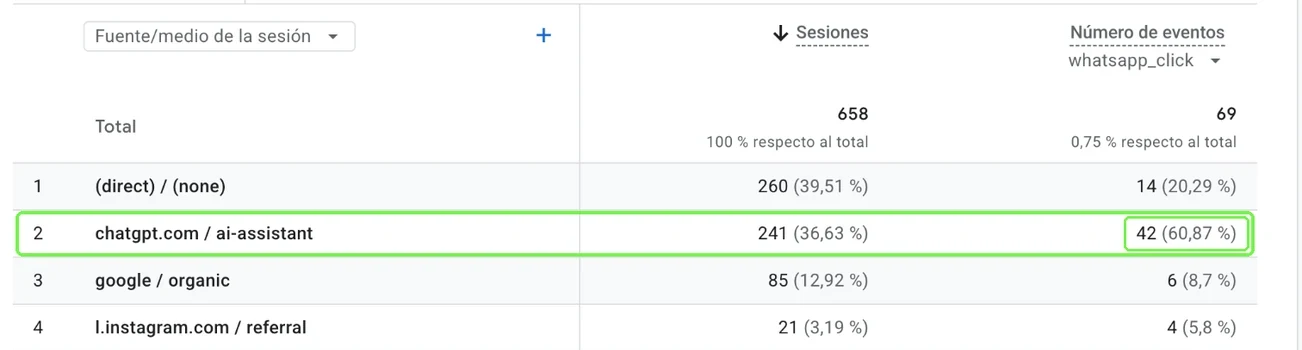
Real case · Plastic surgeon in Bogotá
More than 10 patients booked in his first 3 months. Patients find him on ChatGPT and on Google.
This is the site of Dr. Daniel Ramos, a plastic surgeon in Bogotá.
Patients confirmed by the doctor as of 4 October 2026. Clicks and visits: his Google Analytics; the 73% is from September (2–29) and the screenshot covers 1 July to 25 October. A real case, not a promise.
Demo call · free
Tell us about your business. We'll show you how to reach the first page.
It's for getting to know each other. You tell us about your business, we research for free how people search for you and what it would take for you to show up, and we show you live how an agentic website works.
- You tell us about your business
- We research how people search for you, and how much
- We show you how to show up and how we work
20-minute video call, in English or Spanish. Free, no commitment. If we're not a fit, we'll tell you straight.